
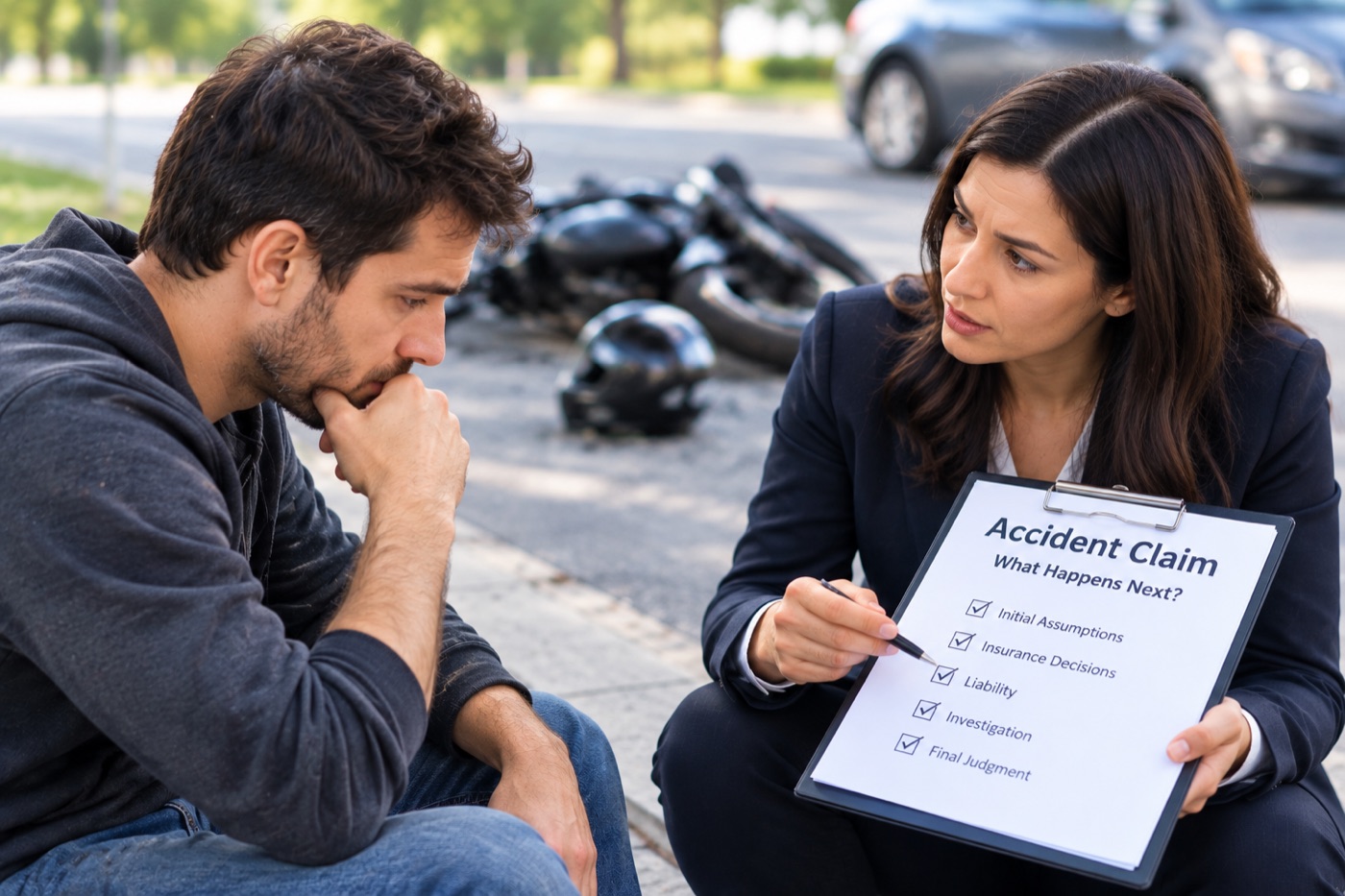
A Raleigh motorcycle accident claim is decided under North Carolina’s contributory negligence rule: if the rider is found even slightly at fault, recovery can be barred. That makes the first weeks critical. The bike, your gear, nearby video, and the other vehicle’s data are the evidence that answers the defense, along with knowing which damages and insurance apply.
Any rider who has spent a season here knows the pattern: good back roads outside the Beltline, mild weather, and a fast-growing city full of drivers still learning its interchanges. That mix produces the same crashes again and again.
Why are motorcycle claims judged before they are investigated?
Many of the people who evaluate a rider’s claim, including adjusters, defense lawyers, and some jurors, arrive with an opinion already formed: motorcycles are dangerous, riders accept the risk, and the rider was probably going too fast. None of that is evidence, but it is in the room from day one.
Three things keep that bias alive.
Severe injuries get read backward. An impact that leaves a driver shaken can fracture a rider’s pelvis. People see serious injuries and assume serious speed, even though the difference is protection, not velocity.
The loudest bike sets the image. A careful commuter gets judged against every reckless rider people have seen on I-540.
The driver genuinely did not see the rider. Motorcycles have a small visual profile, and drivers scanning for cars can miss them. “I didn’t see the bike” becomes “it came out of nowhere,” which becomes “the rider must have been speeding.” That chain is the most common liability defense in motorcycle cases, and it often starts with a driver who is not lying.
How does North Carolina’s contributory negligence rule affect a motorcycle claim?
North Carolina is one of the few places that still applies pure contributory negligence, along with Alabama, Maryland, Virginia, and D.C. In most states, a rider found 20% at fault loses 20% of the award. Here, a rider found even 1% at fault can recover nothing.
That changes the defense’s job. It does not need to win the argument about who caused the crash. It only needs to plant a sliver of doubt about the rider. Expect questions about:
- Speed, even a few miles over the limit
- Lane position within the lane
- When and how hard the rider braked
- Signaling and lane changes
- Aftermarket parts, such as exhaust or lighting
Any one of those, if accepted, can end a claim. Our article on why contributory negligence still haunts injury victims in North Carolina explains how the rule survived when most states abandoned it. “Obvious” is not a defense against a 1% standard, which is why even clear-cut claims get built with reconstruction analysis and hard data.
Are there exceptions that help riders?
Yes, two important ones. Under the last clear chance doctrine, a rider who was partly negligent may still recover if the driver had the last clear opportunity to avoid the crash and failed to take it. And contributory negligence generally is not a defense when the driver’s conduct was willful or wanton.
Last clear chance can matter where a driver saw a rider in trouble, such as a rider down after hitting debris, and still had time to stop or steer away. Neither exception is automatic. Both depend on evidence gathered early.
Where do motorcycle crashes happen in Raleigh?
Raleigh riders will recognize the list. The roads matter because they shape the crash pattern and what evidence exists. A crash on a busy commercial corridor may be on several business cameras. A crash on a rural two-lane road may have no video at all, so physical evidence at the scene carries the case.
Capital Boulevard. Multiple lanes, dense commercial frontage, and a near-continuous run of driveways and curb cuts. Vehicles pull out across traffic constantly, which creates intersection pull-out and turning crashes.
Glenwood Avenue and Glenwood South. Heavy nighttime traffic, rideshare vehicles stopping without warning, pedestrians stepping between parked cars, and, some nights, impaired drivers.
The Beltline and the I-440/I-40 merges. Traffic weaves across several lanes in short distances. Lane-change crashes involving motorcycles tend to happen in these merge zones, especially at rush hour.
Six Forks Road, Falls of Neuse Road, and Wake Forest Road. Long commercial stretches with unprotected left turns. The left-turn crash, where an oncoming driver turns across the rider’s path, is one of the most dangerous situations a motorcyclist faces.
Rural transitions toward Rolesville and Zebulon. Speeds climb and driveways hide behind tree lines. Skid marks and the debris field need documenting before the next rain.
What evidence should you preserve after a Raleigh motorcycle crash?
The most valuable evidence in a motorcycle case has a short shelf life. Preserve the motorcycle, your helmet and gear, and any video. Get medical care right away, photograph your injuries as they heal, and avoid a recorded statement to the other driver’s insurer. Each step closes a door the contributory negligence defense would otherwise use.
Keep the motorcycle as it is. Do not authorize repair, sale, or salvage. Damage patterns show impact angle and force. If the insurer declares a total loss and wants to take the bike, ask that it be held until it can be inspected. Photograph every surface first, including the underside and the controls.
Keep your gear unwashed. Helmet, jacket, gloves, and boots show abrasion and impact patterns a reconstructionist can read. A damaged helmet also shows you were wearing one, which matters because North Carolina has a universal helmet law (§ 20-140.4).
Secure video within days. Business cameras along corridors like Capital Boulevard often overwrite footage within days or weeks. If you or a riding partner ran a helmet camera, back up the file today. A written preservation request has to reach a business before its system records over the crash.
Look for the other vehicle’s data. Many cars have an event data recorder that stores pre-crash speed, braking, and steering. That data can directly answer a “the rider was speeding” defense, but it has to be requested and preserved.
Get the crash report, then read it carefully. The DMV-349 report comes from the investigating agency or NCDMV. It is an officer’s summary, often built from the only party still standing and talking, and it does not decide civil liability. Our guide on how to read your Raleigh accident report walks through the codes and diagrams.
Get evaluated even if you walked away. Spinal, internal, and brain injuries do not always show up on day one, and a treatment gap hands the defense a causation argument.
What damages do injured riders often underclaim?
Medical bills are the starting point, not the whole claim. Serious motorcycle injuries frequently involve surgery, hardware, and long rehab, and many riders never account for losses that continue after the last appointment. A complete claim looks forward, not only back at bills already paid.
Commonly missed categories include:
- Future medical care: hardware removal, revision surgery, ongoing therapy, and pain management
- Lost earning capacity: not just missed paychecks, but a reduced ability to do the same work going forward
- Scarring and disfigurement: road rash and surgical scars change fast, so photograph each stage of healing
- The bike and gear: quality helmets, armored gear, and aftermarket parts add up quickly
- Loss of enjoyment of life: including riding itself, if you cannot ride again or cannot ride the same way
For a broader look at how these cases work statewide, see our overview of motorcycle accident claims in North Carolina.
What happens when the driver’s insurance is not enough?
Serious motorcycle injuries often exceed the at-fault driver’s liability limits. When that happens, your own underinsured motorist (UIM) coverage can become the most important policy in the case. Most riders do not know their UIM limits, and it is worth checking your motorcycle policy and your auto policy today.
North Carolina’s minimum liability limits rose to 50/100/50 for policies effective on or after July 1, 2025, and UIM became “excess” coverage, meaning it adds to the at-fault driver’s limits instead of being reduced by them. For riders with serious injuries, that change can make a meaningful difference in the coverage available.
UIM claims come with strict rules. Settling with the at-fault driver without proper notice to your own UIM carrier can jeopardize that coverage (§ 20-279.21(b)(4)). If the driver fled and cannot be identified, uninsured motorist (UM) coverage can apply. Our guide to UM and UIM coverage in North Carolina explains the notice steps in more detail.
How long does a rider have to bring a claim?
A North Carolina personal injury claim generally must be filed within three years of the injury, and a property damage claim for the bike also has three years (§ 1-52).
The deadline that matters first is the evidence deadline: video overwrites, bikes get scrapped, and witnesses forget. That window is measured in days and weeks.
Talking with RHD Legal after a Raleigh motorcycle crash
A few days after a crash, the bike, the footage, and the witnesses’ memories usually still exist. You can read more about how our firm handles motorcycle crash cases in Raleigh. RHD Legal offers a free consultation, works on a contingency fee with no upfront cost, and is available 24/7. Call (919) 246-4001 or contact our firm and describe what happened.
Frequently Asked Questions
I wasn’t wearing a helmet. Does that end my motorcycle claim?
North Carolina’s helmet law (§ 20-140.4(b)) specifically bars an insurer from treating a bare helmet violation as contributory negligence per se. It cannot, by itself, be used to establish that the rider caused the crash. Insurers sometimes still try to argue that not wearing a helmet made head-injury damages worse (a different question from fault), so the issue isn’t fully off the table, but the ‘no helmet = no claim’ argument some adjusters lean on has no basis in NC law.
The police report says the crash was my fault. Is my claim over?
No. The DMV-349 crash report does not decide civil liability. It reflects an officer’s opinion formed after the fact, often from the driver’s account while the rider was being treated. Physical evidence, witness statements, video, and the other vehicle’s event data can contradict the report, and they often carry more weight when a claim is evaluated.
The driver says I came out of nowhere. How is that disputed?
With physics and data. Crush damage, throw distance, skid and yaw marks, and sightline measurements show where each vehicle was and how fast it was moving. The other car’s event data recorder may show its own speed and steering before impact. Video from Raleigh businesses or a helmet camera can settle the question outright if it is preserved in time.
Should I let the insurance company take my totaled motorcycle?
Not before it has been documented and inspected. Once a totaled bike is sold at salvage, the damage evidence that answers speed and impact-angle arguments is gone. Photograph it thoroughly, and ask in writing that the bike be held until an inspection is complete. Then decide on the property damage claim.
What if the driver who hit me left the scene?
Leaving the scene of a crash involving injury is a crime in North Carolina (§ 20-166). For your claim, uninsured motorist coverage can apply when a hit-and-run driver cannot be identified. Report the crash to police and your insurer promptly, because reporting timelines and proof rules for these claims can be strict.
This article provides general information and is not legal advice. The laws and deadlines that apply to your situation depend on the specific facts of your case. For advice about your circumstances, speak with a licensed North Carolina attorney.